Best Universities for Pharm D in Pakistan: A Complete Guide for Students

Choosing the right university for a Doctor of Pharmacy (Pharm-D) is an important decision for students who want to build a career in healthcare, pharmaceutical industries, clinical pharmacy, research or other areas of the pharmacy profession. Pakistan has many public and private institutions offering pharmacy education but choosing the right one requires more than simply looking at a university’s name. Students should consider factors such as academic quality, recognition, curriculum, faculty, laboratory facilities, practical learning, internships, location, admission requirements, fee structure and career support. This guide explains the key factors students should consider when comparing the best universities for Pharm D in Pakistan and provides useful information for students considering pharmacy education, particularly in Lahore.
What Is Pharm-D?
Doctor of Pharmacy commonly known as Pharm-D, is a professional degree that prepares students for different areas of pharmaceutical and healthcare practice. The program combines theoretical knowledge with practical learning in subjects related to medicines, pharmaceutical sciences, pharmacology, pharmaceutics, pharmaceutical chemistry, pharmacy practice and therapeutics.
The Higher Education Commission’s revised Pharm-D curriculum provides a framework covering pharmaceutical sciences, pharmacy practice, research, communication, leadership, innovation and professional development. The revised curriculum is structured over a minimum of 10 regular semesters. Students should always check the latest requirements issued by the relevant authorities and their selected university before applying.
A Pharm-D education can open pathways into pharmaceutical manufacturing, quality control, hospital pharmacy, community pharmacy, research, regulatory affairs, academia and other related fields.
What Makes a Good Pharm-D University?
The word “best” can mean different things to different students. A university with a convenient location may be the right choice for one student, while another may prioritize laboratories, research opportunities, clinical exposure, affordability or faculty expertise.
Therefore, students should compare universities using clear and practical criteria.
Recognition and Professional Status
Recognition should be one of the first things students investigate before applying to a pharmacy program. Pharmacy is a regulated professional field, so applicants should verify the current status of the university and its pharmacy program through the appropriate authorities.
The Pharmacy Council of Pakistan provides information about institutions offering Pharm-D. Students should use current official information rather than relying only on old articles, social media posts or third-party university lists. It is also important to confirm whether the university’s current admission offering matches the program information published on its official website.
Curriculum and Academic Learning
A strong pharmacy program should provide students with knowledge that can be applied in professional settings. Students should review the subjects included in the curriculum and determine whether the program covers both pharmaceutical sciences and practical aspects of pharmacy.
Important areas can include pharmacology, pharmaceutics, pharmaceutical chemistry, pharmacognosy, pharmacy practice, clinical pharmacy, pharmaceutical analysis and related disciplines.
Students should also look for opportunities to develop communication, research, teamwork, problem-solving and professional skills. These abilities can become increasingly important as graduates move from university into professional environments.
Laboratory and Practical Facilities
Pharmacy is not purely a classroom-based discipline. Practical learning allows students to connect scientific concepts with real procedures and applications.
When visiting a university, prospective students should ask about its pharmacy laboratories and practical facilities. They can also inquire about laboratory sessions, equipment, pharmaceutical formulation activities, analysis work, research facilities and other opportunities for hands-on learning.
A university’s practical environment should complement its classroom teaching and help students develop confidence in applying their academic knowledge.
Faculty and Academic Support
Faculty members have a direct influence on the learning experience. Students should consider the qualifications, experience, teaching background and professional or research involvement of faculty members.
Academic support is another factor worth considering. Students may benefit from mentoring, academic advising, career guidance and opportunities to interact with teachers outside regular classroom activities.
A supportive academic environment can help students identify areas where they need improvement and develop stronger professional goals.
Internships and Industry Exposure
Pharmacy graduates can enter a range of professional areas, so exposure to real-world environments can be valuable during their education.
Students should ask whether a university provides opportunities for internships, pharmaceutical industry visits, hospital interactions, seminars, workshops, research projects and professional mentoring.
Hajvery University’s Faculty of Pharmacy describes its academic approach as industry-driven and highlights hands-on experience, specialized internships and mentoring programs as part of its educational environment.
Students interested in learning more about its programs can explore the Hajvery University Faculty of Pharmacy for information about the Pharm-D and M.Phil Pharmacy–Pharmacology programs.
Universities Offering Pharm-D in Pakistan
Students can find Pharm-D programs in different parts of Pakistan including Punjab, Sindh, Islamabad, Khyber Pakhtunkhwa, Balochistan and other regions.
There are public-sector and private-sector institutions offering pharmacy education and each may differ in terms of admission requirements, fees, campus facilities, teaching environment, location and student services.
Rather than relying on an online list that declares one institution the “number one” university, students should create a shortlist based on their own requirements.
A useful comparison can include:
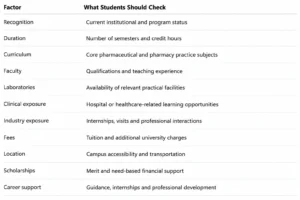
This approach gives students a more useful comparison than simply following a ranking published by an unofficial website.
Pharm-D Universities in Lahore
Lahore is an important higher education center in Pakistan and provides students with several options for pharmacy education.
Students considering Lahore should compare institutions according to their academic goals, budget, preferred location, facilities, admission requirements and learning environment.
Hajvery University is one of the institutions offering Pharm-D in Lahore. Its Faculty of Pharmacy offers the Doctor of Pharmacy program alongside an M.Phil Pharmacy – Pharmacology program. The university’s Faculty of Pharmacy page also highlights hands-on learning, internships, mentoring and an industry-oriented curriculum.
The university’s wider campus facilities include specialized pharmacy laboratories, along with modern teaching facilities across its campuses.
Pharm-D at Hajvery University
Hajvery University offers a five-year Doctor of Pharmacy program through its Faculty of Pharmacy in Lahore. The program is designed to provide students with knowledge of pharmaceutical sciences and related professional areas.
The Faculty of Pharmacy currently lists two degree options: Pharm-D (Doctor of Pharmacy) and M.Phil Pharmacy – Pharmacology.
The university describes its academic environment as focused on industry relevance, hands-on experience, internships and mentoring. These elements can be useful for students who want to connect classroom learning with professional development.
Hajvery University’s wider academic environment also includes modern campuses and specialized facilities, including pharmacy laboratories.
Students should contact the university directly for the latest admission dates, fee structure, scholarship availability and current eligibility requirements because these details may change between admission cycles.
Public vs. Private Universities for Pharm-D
Students often compare public and private universities when selecting a pharmacy program. Both sectors can provide opportunities for professional education but their admission processes, fee structures, facilities and student services can differ.
Public-sector universities may have highly competitive admissions and different fee structures. Private universities may offer different admission schedules, campus facilities and student-support services.
The most useful approach is to compare the actual program rather than assuming that one sector is automatically better.
Students should review recognition, academic quality, practical facilities, faculty, total cost, location, scholarships and opportunities for professional exposure before making their decision.
Pharm-D Admission Requirements
Admission requirements can vary between institutions. Students should always check the latest admission notice published by their selected university.
Generally, students interested in Pharm-D are expected to have a relevant intermediate or equivalent qualification commonly with a Pre-Medical background.
The HEC revised Pharm-D curriculum provides a minimum eligibility framework, while universities may have additional admission procedures according to their approved policies.
Applicants should prepare their academic certificates, transcripts, identification documents, photographs and any other documents specified by the university.
It is also important to check admission deadlines early. Waiting until the last few days can create unnecessary problems, particularly when students need to arrange documents or equivalence certificates.
Career Opportunities After Pharm-D
A Pharm-D degree can provide a foundation for several professional directions. Career options can depend on a graduate’s interests, professional registration, practical experience, skills and further education.
Potential areas include:
- Hospital and clinical pharmacy
- Community pharmacy
- Pharmaceutical manufacturing
- Quality control and quality assurance
- Regulatory affairs
- Pharmaceutical research
- Drug information services
- Pharmaceutical sales and marketing
- Academia and teaching
- Research and development
- Pharmaceutical entrepreneurship
Students should remember that a university degree is only one part of professional development. Communication skills, practical experience, continuing education, networking, research experience and professional requirements can also influence career opportunities.
How to Select the Right University
Before making a final decision, students should create a shortlist of universities and compare them using the same criteria.
Start by checking recognition and program status. Then compare curriculum, faculty, laboratories, practical training, internships, fees, scholarships, campus location and student support.
It is also useful to visit the campus when possible. Speaking with current students and asking specific questions about laboratories, teaching methods, practical work and academic support can provide information that may not appear on a university website.
Most importantly, verify important information from official sources. Fees, admission dates, eligibility requirements, available programs and regulatory status can change so outdated blog posts should not be treated as the final authority.
Why Consider Hajvery University for Pharm-D?
Students searching for a pharmacy university in Lahore can include Hajvery University in their comparison. Its Faculty of Pharmacy offers Pharm-D and M.Phil Pharmacy – Pharmacology and describes an academic environment that emphasizes industry relevance, hands-on experience, internships and mentoring.
The university also states that its campuses provide modern teaching facilities and specialized laboratories, including pharmacy labs.
For students, the important point is to compare these features with their own priorities. The right university should provide an academic environment that aligns with the student’s educational goals, financial situation, preferred location and intended career direction.

Conclusion
Selecting among the best universities for Pharm D in Pakistan requires careful research rather than relying on a simple online ranking. Students should evaluate recognition, curriculum, faculty, laboratory facilities, practical learning, internships, fees, scholarships, location and career-development opportunities before applying. Checking information through official university and regulatory sources can also help students avoid relying on outdated or inaccurate information.
For students interested in studying pharmacy in Lahore, Hajvery University offers a Pharm-D program through its Faculty of Pharmacy, alongside an M.Phil Pharmacy – Pharmacology program. Its published faculty information highlights hands-on learning, industry relevance, internships, mentoring and specialized academic facilities. Students can review the Hajvery University Pharm-D and Pharmacy programs and contact the university for current admission, fee and scholarship information.
Frequently Asked Questions
1. Which universities offer Pharm-D in Pakistan?
Several public and private universities and institutions offer Doctor of Pharmacy programs across Pakistan. Students should check the current institutional information provided by the Pharmacy Council of Pakistan and the university’s official website before applying.
2. What should I consider when choosing a Pharm-D university?
Students should consider recognition, curriculum, faculty qualifications, laboratory facilities, practical learning, internships, fees, scholarships, campus location and career-support opportunities. It is better to compare these factors than to depend entirely on an online ranking.
3. Does Hajvery University offer a Pharm-D program?
Yes. Hajvery University’s Faculty of Pharmacy offers a Doctor of Pharmacy (Pharm-D) program in Lahore. The faculty also lists M.Phil Pharmacy – Pharmacology as a postgraduate program.
4. What career options are available after Pharm-D?
Graduates can explore areas such as hospital pharmacy, community pharmacy, pharmaceutical manufacturing, quality assurance, quality control, regulatory affairs, research, pharmaceutical marketing, academia and other pharmacy-related fields.
5. How can I find the latest Pharm-D admission and fee information?
The safest approach is to check the official website of the university you are considering and contact its admissions office. Admission dates, eligibility requirements, fees, scholarships and available seats can change between admission cycles, so current official information should be used before submitting an application.